Charlie Morrissey
Vessel Name: Afric
Charlie Morrissey
Afric
Drowned; body not recovered
15 February 1915
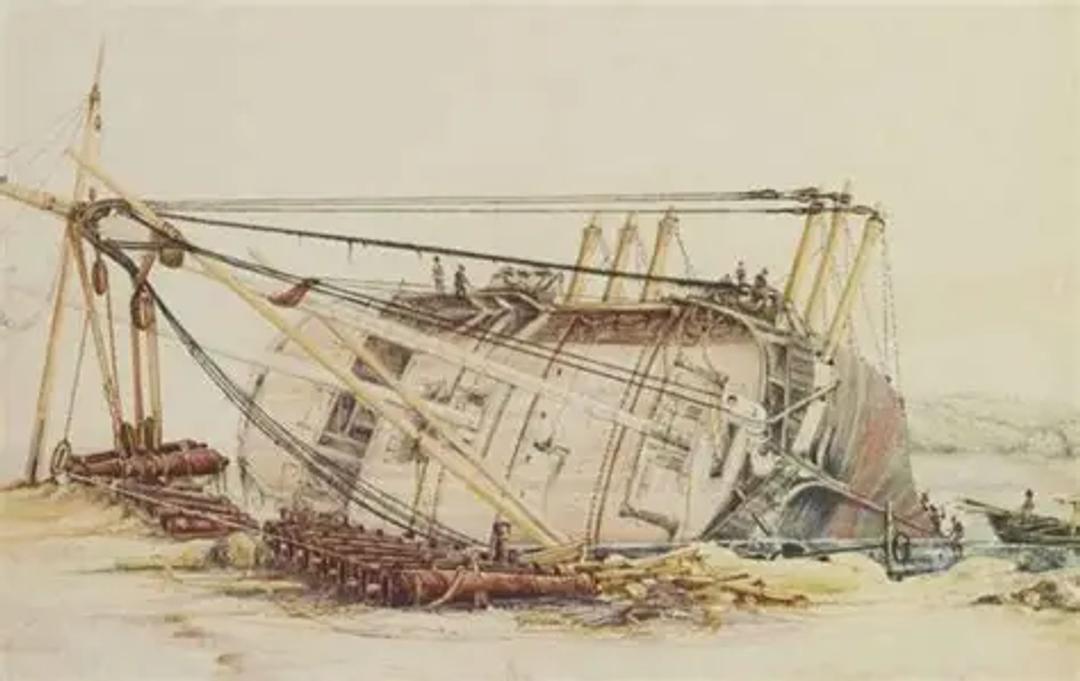
Careening. Courtesy of Model World
The schooner Afric was built by the reputable boat builders W & S Lawrence of Fremantle and registered with the official number 119002. She had two masts [fore and main] and her hull shape made her suitable for the harsh conditions of the northwest coast of Western Australia. Her dimensions were 10.6 metres long, 3.6 metres across her beam and she had a draft of 1.5 metres. At 14.9 tons Afric was ideal for beche-de-mer diving around the islands off the Kimberley coast.
Charlie Morrissey was a well-seasoned seaman who came from Baltimore, Maryland in America. Interestingly for the times, Charlie had no desire to own a boat. He preferred to partner with boat owners on a shared catch basis.
Charlie spent many years on board pearl boats. He began as a beachcomber, became a diver, then a shell opener, and finally a master. In 1900 he was stabbed multiple times while asleep on board the Thistle. Charlie was rescued by the other crew members and survived. Mohamet Bin Ali, a Thistle crew member, was charged with his wounding.
After this incident Charlie ventured into various types of fishing. In 1909 he was master of a vessel in a survey fleet navigating the Kimberley reefs and islands to provide charts for pearlers and fishers venturing south from Darwin and north from Shark Bay and Cossack.
In 1915 Charlie visited pearl boat owner Robert Child in Broome. He requested a 12-month lease of the schooner Afric to go trepang [beche-de-mer] fishing in King Sound. An agreement was made, and Charlie successfully applied for a permit to collect trepang on the Kimberley coast.
Next Charlie recruited three crew members:
Ahmat bin Binullia - a 45-year-old Indigenous diver with 27 years of experience,
Jose - from Peru, 57 years old with 30 years of pearl boat experience, and
Osman Binallo - a 44-year-old Javanese with 25 years of experience.
On 21 January 1915, the crew began loading Afric with provisions, supplies and equipment for trepang fishing. On 25 January, with clearance papers signed, Charlie and his crew left Broome and sailed the schooner north heading for Sunday Island.
Once there Charlie recruited the final member of his crew from the Sunday Island Mission, an Indigenous man named Whogau, more commonly known as Teddy.
While at the island the men careened Afric. Although the trip north had been a gentle one, the schooner needed some work on her hull. Anchored close to the beach, she lay canted on one side while repairs were made.
As the tide rose again Ah Mat noticed water leaking from above a plank that had parted. The plank had been repaired, and Charlie was keen to get to Chile Creek. His drying and smoking racks were there and he wanted to make them ready for the beche-de-mer they would catch on the way. He decided to repair the leak once they got to Chile Creek.
On 2 February Afric weighed anchor and they began to search Charlie’s known fishing spots. All went well and they were finding a good number of trepang. They were diving 10 miles south of Chile Creek, off Cape Leveque. They had to haul north around Swan Point and then turn south to reach their destination.
On 15 February Afric became sluggish and there was unusual noise coming from below deck. When the men investigated, they found the forward hold half full of water. The plank near the leak had shifted allowing water into the boat.
Charlie let go the anchor and ordered the dinghy over the side. The sails were lowered. The crew knew they were sinking.
Charlie, Ah Mat and Teddy took the stores and provisions ashore, approximately one mile away. Then Charlie and Teddy went back, pulling hard because the Afric was being dragged north by the changing tide. The men re-boarded and took their bedding and sails. Osman and Jose got into the dinghy, and they headed for shore once more.
Charlie and Teddy returned to the schooner one last time. Charlie climbed aboard and told Teddy to remain alongside. Then he weighed the anchor. It is possible Charlie intended to run the boat into the shore, but a rip caught her and swept her out to sea, full of water with her deck almost under water.
Charlie grabbed the foremast as Afric rolled over. Her rigging smashed into the dinghy. It capsized and Teddy was thrown into the water. He made the dinghy and righted it. Without oars he could only drift with the tide. He grabbed some hatch boards that were floating free of the sinking schooner.
As Afric was washing north of Sunday Island, the men onshore near Swan Point could only watch in horror as their boat rolled over. They watched the rigging fall and knew they were stranded.
Teddy saw Charlie tangled in the rigging, unable to free himself. He went down with the Afric. He did not some to the surface again. Teddy remained with the schooner as long as he could, until the tide separated them.
Finally, that evening the tide changed and the dinghy was pushed close to Sunday Island again. Teddy used the hatch boards to paddle to the beach.
Teddy walked to the mission and told their leader Sydney Hadley the Afric was lost, and Charlie had drowned. Sydney sent a message to lightkeeper Abercrombie at the Cape Leveque lighthouse. The lightkeeper alerted Mr Hunter at the nearest station on the mainland, and the men stranded near Swan Point were taken to the lighthouse.
On 25 February Police Constable Thomas Rhea arrived from Pender Bay Station. He interviewed Teddy and then went to the beach to investigate, recover and the men’s supplies. They would need them because it would be some time before the crew could be returned to Broome.
There was no trace of the Afric or Charlie Morrissey. It was assumed he remained tangled in the rigging at the bottom of the ocean. Charlie was 56 when he drowned on 15 February 1915.
A severe cyclone struck the Kimberely coast in March that year, a month or so after the Afric sank. Part of her rigging with her sails attached was washed ashore on the mainland and was discovered by luggers searching for boats and crew who had survived. The wreckage had surfaced in the unusually heavy tides and was identified by the Broome masters who were working around Cape Leveque.
Due to the distance from the northwest coast and the minimal news coverage in the Kimberley at that time, it was reported Affric was lost in the cyclone with a large number of boats from the pearling fleet. No sign of Charlie was found, of course. He had drowned over a month earlier. The rigging gave no clue to his demise.
Police reports and crew statements questioned Charlie’s decision not to run Afric ashore when he had the opportunity. They did not understand why he boarded her for the third time when the crew, their supplies and their possessions had been taken ashore. The answers to those questions are at the bottom of the sea with Charlie Morrissey and the wreck of the Afric.